Ventura Transit Trip
The Route
Drive to Solana Beach Station
Pacific Surfliner 567 to Los Angeles Union Station
Metrolink VC Line 1163 to East Ventura
GCTD Route 6 to Santa Clara and Fir
Solana Beach Station
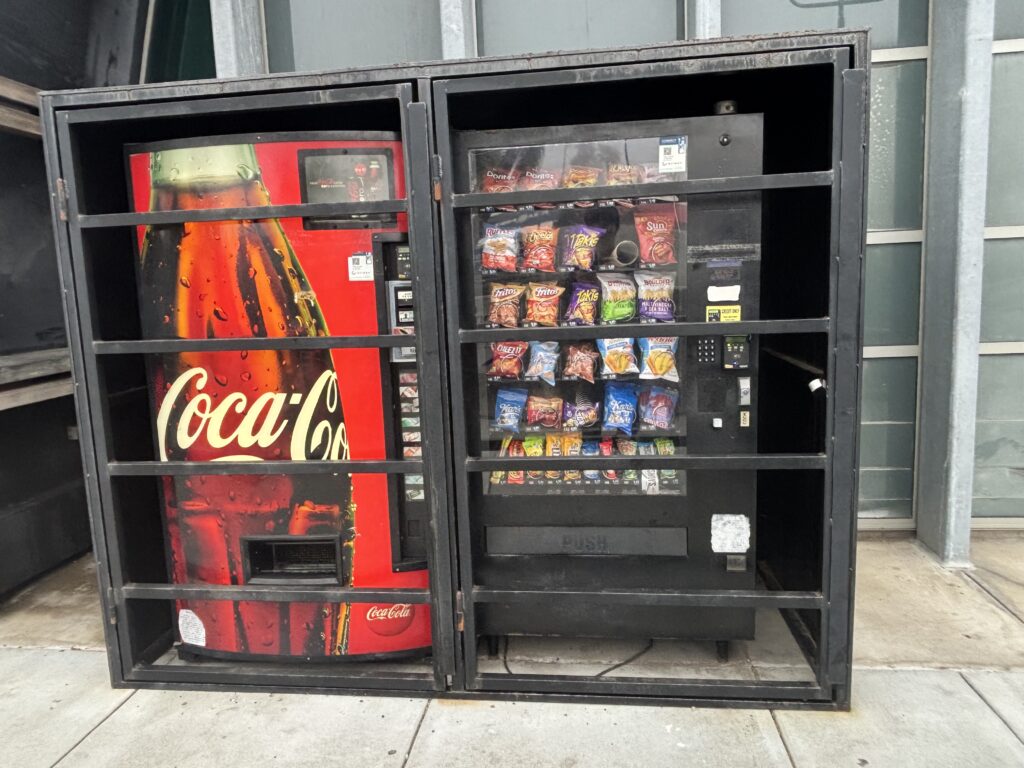
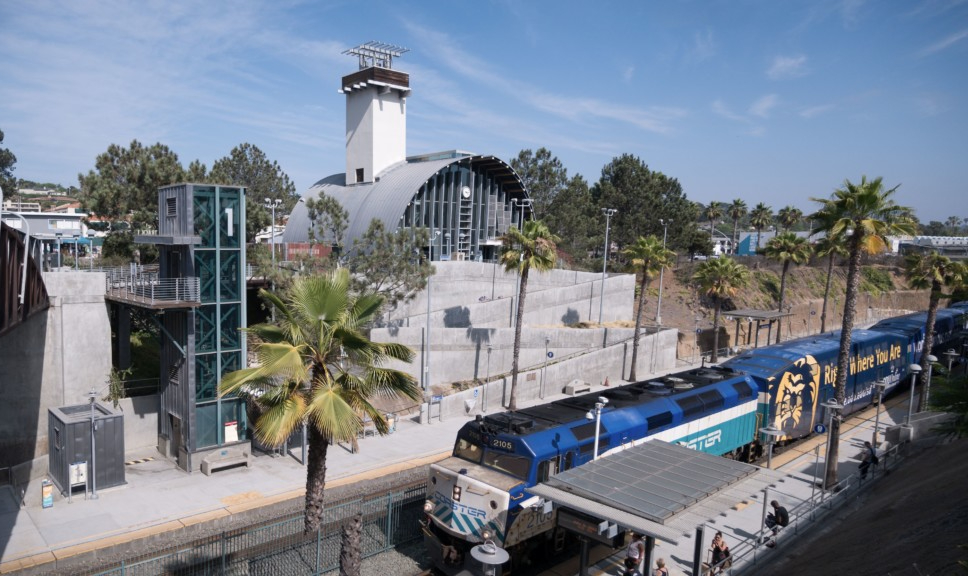
We started the journey at Solana Beach Station which, fun fact, was inspired by the military-era Quonset huts during World War II. It features actual bathrooms (that are open), a staffed Amtrak ticket office, some benches, and my personal favorite, vending machines in jail.
The platforms at Solana Beach are pretty normal, being standard low-level with mini-highs. When you want to get down to the actual platform though, it gets pretty interesting. For the southbound platform, you have a choice of a non-ADA accessible ramp, an ADA accessible ramp, a staircase, or an elevator, making for one of the most overbuilt platforms ever. For the northbound platform, there is a bridge that ends at the Highway 101 sidewalk. From the bridge, there is an elevator (which is surprisingly clean!) and from the sidewalk, there is a set of stairs. The tracks run on the left-hand side for some reason, which is weird, and there seems to be no apparent reason why.
Pacific Surfliner – Northbound
We boarded Pacific Surfliner #567 at 7:40 AM, an on time departure, and started our almost 5 hour journey up north. The consist for that day was the standard one with a Siemens Charger, 1 Superliner car, then a few Surfliner cars, and finally one cab car at the end. The coach seats were comfortable, with reclining cloth seats, a big tray table, and 1 power outlet, but the interiors of these trains are quite dated, being from the 2000s. We pulled out of Solana Beach and made our journey up to LA Union Station. Going through the northern San Diego beach towns the view was mostly of surf shops, houses, and the occasional glimpse of the ocean. One of the highlights of the journey was at San Clemente Pier, where the train stops quite literally on the beach, next to a small commercial strip. When the tracks entered Irvine, the scenery shifted from coastal to industrial/suburban, which continued throughout most of the trip. We stopped at San Juan Capistrano Station which was a quaint single-track platform in the heart of the historic downtown. After Orange County, we quickly approached the Gateway Cities, and the landscape started getting very industrial, especially after the BNSF yard when we started paralleling the LA River. I was quickly subjected to views of green water, grafitti, the backs of warehouses, and a lot of trash. We split off the river, and the train slowly pulled into LA Union Station, concluding the first leg of the trip up north.
Metrolink VC Line
We picked up a to-go order from Subway at LA Union Station and quickly went on our way for the next leg of our trip up north. The Metrolink interior was a typical commuter train layout, with fixed vinyl seating and some 4-seater tables. One thing I noticed is that the seats had no charging outlets, which seemed odd for a commuter train this new. The interior was clean but ridership was not as I would expect, with the cars being mostly empty. We quickly pulled out of LA Union Station on time, and I started making progress on my sandwich while views of more industry passed by. Soon, the train entered the Montalvo Cutoff, which is a rail line constructed in 1904. It started off with a perfectly straight shot through the San Fernando Valley, stopping at Burbank Airport, Van Nuys, Northridge, then Chatsworth. Soon after, we hit the Santa Susana Pass, which includes the 1.5-mile-long Santa Susana Tunnel. The pass was quite short however, and Simi Valley was the next section. Soon after, we split off on a tiny spur under the 101 and did a slow backing maneuver into the lonely East Ventura station, which was right next to a trucking yard and some auto repair shops.
GCTD Route 6
The next and final leg of our journey was the Gold Coast Transit District Route 6 from the Grand and Bristol stop in the Montalvo area (where the Montalvo Cutoff gets its name). The stop that serviced the station was about a 5-minute walk away, and just a concrete pad with a sign. There was no bench and no shade, so I was thankful for the coastal weather. I have no idea what happened to the schedule, because the buses did not line up with the timetable at all. Thankfully, there were lots of buses on the line, so after a 20-minute wait, a bus pulled around the corner and we were on our way.
As it turns out, GCTD is very old school. Route 6 stops seemingly every 2 blocks, and those stops are used quite a bit too. The result? It took 40 minutes to complete a distance that would have taken 9 minutes by car, and no, I’m not exaggerating. To put that into perspective, that is a 10.65 mph average speed, finishing at about the same speed as an elite runner. After an eternity, the bus finally pulled up to the curb at Santa Clara and Fir and we were off on our walk to the hotel.
In Ventura, the speed of transportation is clear: driving first, biking second, the bus third, and walking still slowest.